Showing posts with label Events. Show all posts

November 18, 2013

New drinking laws prompt civic action by college students

New drinking laws prompt civic action by college students

 
Minnesota Public Radio
 
College students in central Minnesota are learning a few life lessons on how government works. The subject at hand -- three new ordinances designed to control underage drinking in the city of St. Joseph. 
            
Students were caught off guard by the new rules and now they're getting more active in city lawmaking. Will Moore, a graduating senior at St. John's University, has the latest installment in our Young Reporters series.  
 
By Will Moore
St. Joseph is home to the College of St. Benedict, with a concentrated population of students from St. Ben's and St. John's University. In fact, college students make up more than a third of St. Joseph's population -- 2,380 students live in the city, which has a total population of 6,534, according to census figures.
          
The three new laws went into effect in March. The first requires landlords to sign a keg permit acknowledging beer will be served on their property. The second allows police to charge people who are drunk with a misdemeanor if they're uncooperative with police.
          
The third ordinance holds hosts responsible if any minors drink alcohol at their social gatherings. The social host law is getting a lot of attention from students 21 and over because they fear the repercussions of socializing with mixed-age groups.
Shane Schiavo, 22, is a senior at St. John's. Schiavo is originally from Marshall, but now lives in St. Joseph, and he believes the punishment for violating the social host ordinance is too severe.
"One silly mistake and you get a misdemeanor, mandatory court appearance, possible jail time, up to a $1,000 fine that sticks with you for the rest of your life and can haunt you in your job search, can haunt you in anything," he said. "The punishment does not match the crime."

Neither city nor school officials informed students about the new ordinances until after they were passed in January. After several weeks of growing confusion, students organized a special meeting to get more information.

A meeting of the school's "Politics and a Pint" series focused solely on this topic. The series, which is hosted by students and focuses on a variety of issues, allows alcohol to be consumed by attendees who are 21 and older. Political science professor Matt Lindstrom moderates the series.

"We're going to hear all about kegs and social host ordinance, what that means, and also -- pay attention -- what it doesn't mean. And that's, I think, just as important," said Lindstrom.

A few hundred students packed Brother Willie's, the on-campus pub at St. John's, to hear public officials speak, including the mayor of St. Joseph, a council member and Police Chief Pete Jansky. Jansky told the students they're not the only ones concerned about the social host ordinance.
          
"Many of the cities, especially the ones with college communities in them, have the social host (law)," Jansky said. "We're the community that's probably one of the late bloomers coming through. Why did we do that? Because we wanted to do it right."
          
The Twin Cities suburb of Chaska passed the state's first social host ordinance in 2007, after a 19-year-old man who had attended a party in the city froze to death walking home while drunk. Now, more than 80 Minnesota cities and towns have passed some sort of social host law, and they cover more than half the state's population.
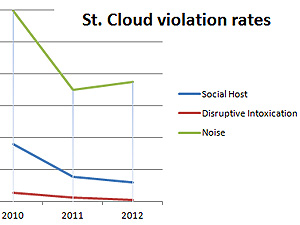
St. Cloud is one of those cities, and is home to a large student population from two schools in the area. Since St. Cloud's law went into effect three years ago, the city has seen a decline in public drunkenness, noise violations, and alcohol-related emergency room admissions.
          
Noise violations dropped from 418 in 2008 to 188 last year, according to data provided by St. Cloud City Attorney Matthew Staehling. Violations for disruptive intoxication declined from 14 in 2010 to three last year. And social host violations dropped from 90 three years ago to 30 last year. St. Joseph used St. Cloud's law as a template for its own.
          
Chief Jansky said St. John's and St. Ben's have had their own alcohol-related problems.
"Every year that I've been here for the past 12 years we've come very close to losing students because of alcohol poisoning. I think I can unequivocally say all of them were underage," said Jansky.
Even so, some students are not convinced the ordinance will stop underage drinking.
          
"I don't know of anyone who's underage who is going to stop drinking because of these ordinances," said Katie Zuroski, 20, a junior at St. Ben's. "I think that they're going to be sneakier about it and maybe more cautious, but I don't think that's going to change anything."
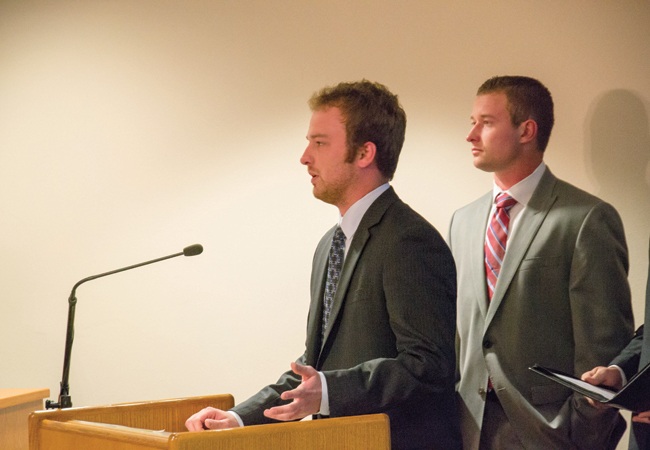
          
Larger view Many other students are using social media to call for better communication and more student involvement in city and school decisions. A Facebook group set up for that purpose attracted more than 1,000 members in its first three days. Even the mayor of St. Joseph joined the online discussion.
Since then, several students have been meeting with city officials regularly to voice their opinions. Senior Jenny Kunkel, 22, of Roseville, says the students who live in St. Joseph are ready to get involved if they're shown how.
          
"To even consider going to a council meeting ... that would be talking about school levies for the middle school or something -- that wouldn't be something I'd instinctively go to," she said. "But if they said, 'Hey, we're talking about something that's going to influence you,' I think people would show up."
          
And they did.
          
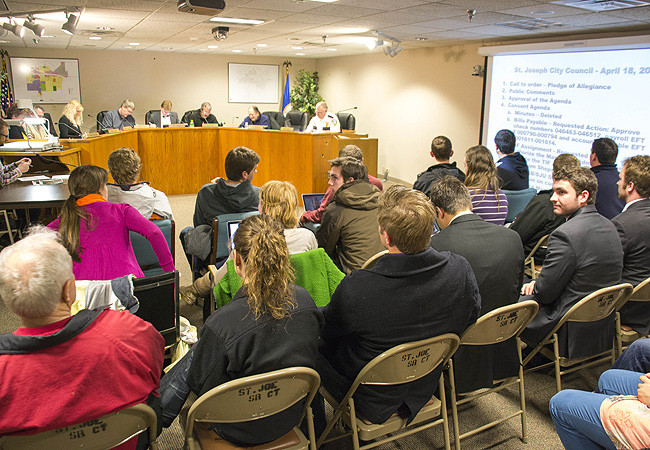
Despite a freak spring snowstorm, dozens of students attended a St. Joseph City Council meeting on April 18, where lawmakers asked them to present ideas. That meeting had a larger student presence than Police Chief Jansky said he'd seen in his decade as chief, and he thinks it's a good sign that students are getting more involved.
          
Students say they hope to reduce the punishment for social hosts. They're working with St. Joseph to put city news in the campus newspaper. And they want to create a program where students work directly with the council so they're more aware of city issues that could have an impact on them. New drinking laws prompt civic action by college students

October 10, 2012

MPR's Kerri Miller to moderate panel at Saint John's on religion and politics on October 25

MPR’s Kerri Miller to moderate panel at Saint John’s on religion and politics

COLLEGEVILLE, Minn. – Minnesota Public Radio host Kerri Miller will be the moderator for the panel program “Religion and Politics in Today’s America: An Interfaith Conversation” at 8 p.m. Thursday, Oct. 25, in the Stephen B. Humphrey Theater at Saint John’s University.

Pastor Leith Anderson, Imam Makram Nu’Man El-Amin, the Rev. Bill Vos and Rabbi Marcia Zimmerman will be the panelists. 


“Religious ideas and convictions have had an historic and important role in shaping political discourse, elections and public policy,” said Matt Lindstrom, director of the McCarthy Center. “This year’s political campaigns at the national and state levels are no different as religious leaders and faith communities play myriad roles.” 

According to John Merkle, director of the Jay Phillips Center, “the panelists will discuss how their religious faith influences their political ideas and commitments, the impact this election season is having on their faith communities and how they deal with apparent and real contradictions or tensions in their religion’s sacred texts and traditions concerning issues found in contemporary politics.”

Miller is host of MPR’s weekday news program “The Daily Circuit.” She has been a radio and television news reporter since 1981 and joined MPR in 2004.

Anderson is president of the National Association of Evangelicals. He served as senior pastor of Wooddale Church in Eden Prairie, Minn., from 1977 until 2011.

El-Amin is resident imam of Masjid An-Nur Minneapolis. He is co-founder of the Muslim American Society of Young Adults.

Vos, a priest of the Diocese of St. Cloud, is director of Catholic Relief Services for central Minnesota and chair of the board of directors of Maryknoll Lay Missioners.

Zimmerman has been the senior rabbi of Temple Israel in Minneapolis since 2001, where she holds the Alvin and June Perlman Senior Rabbinic Chair.

February 16, 2012

Letter: SJU students' spirit at caucus encouraging

The Republican caucus of Collegeville precincts 1 and 2 was held Feb. 7 at St. John’s University, with standing room-only attendance.
It was refreshing and encouraging to see some 40 St. John’s students of Precinct 2 enthusiastically participating and volunteering to be precinct officers and delegates to the next level. Several of these young men spoke in support of candidates, participated in the discussion of platform issues, and interacted in a positive way with the 20 community residents present.
This was a great example of making quality intergenerational connections. I commend these young men for taking the time to become involved in this grass-roots process, and encourage them to continue to be active.


Written by
Bill Lewis
Cold Spring

November 22, 2011

8 CSB/SJU students, professor volunteer for roadside cleanup


Eight students from the College of St. Benedict and St. John’s University, along with Professor Matt Lindstrom, director of the Eugene J. McCarthy Center for Public Policy and Civic Engagement at St. John’s, volunteered for the center’s first roadside cleanup. The McCarthy Center recently adopted a 3.2-mile stretch of highway south of Avon. The cleanup was Oct. 9. The McCarthy Center will invite members of the CSB/SJU community to participate in this cleanup again each spring and fall. Photo submitted by Melissa DeOrio, Eugene J. McCarthy Center for Public Policy and Civic Engagement Written by
Submitted by Melissa DeOrio
Eugene J. McCarthy Center for Public Policy and Civic Engagement


Filed Under
Citizen Times
College Of St. Benedict
Eight students from the College of St. Benedict and St. John’s University, along with Professor Matt Lindstrom, director of the Eugene J. McCarthy Center for Public Policy and Civic Engagement at St. John’s, volunteered for the center’s first roadside cleanup. The McCarthy Center recently adopted a 3.2-mile stretch of highway south of Avon. The cleanup was on Oct. 9. The McCarthy Center will invite members of the CSB/SJU community to participate in this roadside cleanup again each spring and fall.
EmailPrintShare LinkedIn Tumblr StumbleUpon Reddit Del.icio.us Digg AA

June 21, 2011

FactCheck.org founder spends week at SJU

Written by
Mark Sommerhauser
msommerhauser@stcloudtimes.com

Like to follow politics through blogs, Facebook and Twitter?

Use of these and other social-networking platforms may encourage voters to type first and think later, a political expert with Central Minnesota ties said Tuesday.

Kathleen Hall Jamieson directs the Annenberg Public Policy Center at the University of Pennsylvania and helped found FactCheck.org, a pioneering website that scrutinizes statements made by politicians in ads and debates.
Jamieson this week is a scholar-in-residence at the Eugene J. McCarthy Center for Public Policy and Civic Engagement at St. John’s University. That puts Jamieson in familiar territory, as she’s a 1964 graduate of St. Benedict’s High School in St. Joseph.

Few dispute that social-networking platforms have had a growing influence on politics in recent years.

That’s not necessarily bad, Jamieson said in a Tuesday afternoon interview with the Times. Such platforms help people connect with each other, and help them aggregate political information.

But they also may foster a climate in which observers continually comment on political speeches or debates, without pausing to consider or digest what politicians are actually saying, Jamieson suggested. She questioned how this could affect “our capacity for thoughtful citizenship and reflective engagement.”
Politics also is being changed by the emergence of technology to individualize Internet advertising, Jamieson added. That could occur when advertisers use a person’s Internet-surfing history to tailor political emails or ads to that individual.

The result: Different voters hear different political messages — and perhaps, different promises. That’s not necessarily a problem if the claims are accurate — but could be if they’re not, Jamieson said.

“Nothing in the media structure is set to capture these messages, to provide a forum to debunk them,” Jamieson said.

Jamieson also stressed the importance of educating high school students on civics — and on how to distinguish when a politician is telling the truth or when they’re fibbing. Increasing emphasis on core subjects like math and reading mustn’t displace such education, Jamieson said.

“It’s also important,” she said, “that we haven’t crowded an understanding of civics out of our curriculum.”

February 8, 2011

Parker Rosen, LLC Announces Mark Kennedy as Senior Strategic Adviser

January 14, 2011 11:22 AM Eastern Time
Parker Rosen, LLC Announces Mark Kennedy as Senior Strategic Adviser
Former Congressman Adds Depth to the Firm’s International Public Affairs Practice
MINNEAPOLIS--(BUSINESS WIRE)--Minneapolis-based law firm Parker Rosen, LLC, (www.parkerrosen.com), announced today the addition of Mark Kennedy as a Senior Strategic Adviser. Kennedy brings a broad background in business, public service and global initiatives to his role at Parker Rosen, a firm well known for its involvement in Minnesota politics, civic activities and public affairs in addition to its winning tradition in the courtroom representing local, national and international business clients.
“I’m thrilled to be joining Parker Rosen,” says Kennedy. “I’ve long admired the wise counsel and winning results of the firm, its commitment to its clients and its active involvement in bringing people together through its community and public affairs work.”
In his role at Parker Rosen, Kennedy will focus his practice on assisting clients with global public affairs strategy and international conflict resolution matters. Kennedy is also Chief Executive Officer of Chartwell Strategic Advisors, LLC where he applies his experience in both business and government to help clients achieve success in the increasingly globalized and competitive world.
According to Parker Rosen Co-founder, Andrew Parker, “Mark shares our belief that law firms must be focused on results and that achieving results requires expert advice. Mark’s experience in global business and government will help Parker Rosen continue to achieve the results that our clients need and expect in the ever-evolving environment of business and the law.”
Prior to joining Parker Rosen and forming Chartwell Strategic Advisors, Kennedy was in a global role with Accenture, a leading management consulting firm. He represented Minnesota in the United States House of Representatives for three terms from 2001 through 2007. Kennedy also served as a Presidential appointee to the Advisory Committee on Trade Policy and Negotiation under both Presidents Bush and Obama (2007 – 2010). Prior to his service in Congress, Kennedy held leadership roles with some of the area’s largest employers, including Pillsbury, Macy’s and ShopKo (then a subsidiary of SUPERVALU). Trained as a Certified Public Accountant, Kennedy was recognized by Institutional Investor in a feature on America’s Top CFOs.
An active speaker, Kennedy has also founded or co-founded three lecture series: the Minnesota Rough Riders, the Frontiers of Freedom Lecture Series at St. John’s University and the Economic Club of Minnesota (www.ecomn.org). He will continue to speak before civic, government, student and business groups in his role at Parker Rosen.
Kennedy is a graduate of St. John’s University and received his Master’s in Business Administration with distinction from the Ross School of Business at the University of Michigan. He and his wife, Debbie, live in Watertown, Minnesota.
Parker Rosen, LLC (www.parkerrosen.com) is a Minneapolis-based law firm that represents select major corporations, small businesses, and other private and institutional clients in complex civil and commercial litigation, labor and employment litigation and investigations, eminent domain, real estate, and land use law, appellate advocacy, education law and, international law and public affairs. The firm looks to make a difference – in legal matters within the Twin Cities market and throughout the world – by bringing people with diverse backgrounds together to build a unified community.

January 27, 2011

DeLand column: Is there economic logic to a stadium?

DeLand column: Is there
economic logic to a stadium?

January 23, 2011

When Joe Friedrich looks at the issue from a
professional standpoint, it doesn’t make a whole lot
of sense.

What would be the financial benefit to Minnesota
taxpayers of paying for the majority of a new
stadium for the Minnesota Vikings? The economist
in Friedrich will tell you there really is none.

“Economists — except for those who have a vested
interest — pretty much cannot really find a
benefit/cost analysis to support a publicly financed
stadium, to the state or the government interest that
pays for it,” said Friedrich, a St. Cloud resident and
professor emeritus of economics at St. John’s
University and the College of St. Benedict (he retired
18 months ago).

“On the standpoint of strictly economic costs to the
state, I literally can’t find a study that comes up with
a positive return.”

But when Joe Friedrich the native Minnesotan or Joe
Friedrich the lifelong sports fan looks at the same
issue ... well, it’s not so cut-and-dried.

“The Vikings certainly add a lot of excitement,”
Friedrich said. “They do contribute to the spirit of
the state. Think of yourself and all the other people
for whom it’s a very real part of their life.”

Central Minnesotans who stand on divergent sides
of this issue will have the opportunity to talk about
it with Friedrich and others on Thursday.

The Eugene J. McCarthy Center for Public Policy and
Civic Engagement is hosting a discussion titled “
Your Taxes & Sports Stadiums: The Minnesota
Vikings” as part of its Politics & A Pint series.

The forum begins at 4:30 p.m. Thursday at Brother
Willie’s Pub in Sexton Commons on the SJU campus,
and the public is invited to hear Friedrich’s
economic insights on the issue.

“I’m just going to give 5-10 minutes of the ‘this is
the economic cost/benefit’ reality,” Friedrich said.
“I’m sure there’ll be a bunch of people there with
assertions. I intend to mostly ask questions back.”
The stadium issue is one that generates a lot of
emotions and a lot of passion, one way or the other.
However, economists aren’t supposed to operate on
emotion: They’re supposed to work with facts.


And according to Friedrich and other economists,
paying for a stadium doesn’t make much financial
sense to the general public. The return on other
investments — like, say, pre-kindergarten education
— is much higher.

But that doesn’t get you a football team ...

“There’s a lot of other reasons why you might want
to build a stadium,” Friedrich said. “But if you were t
alking strictly dollar-and-cents type of arguments, I
think the case is pretty clear that publicly financed
stadiums cost the public more than they benefit.

“It’s not just the Vikings — it’s just about
everybody. That’s the reason I said I couldn’t find
an economist who had a different opinion who was
an independent. (You’d have to) tell a story that’s
not false, but doesn’t tell the whole story.”

Does a new Vikings stadium make sense in other
respects? That question will be tossed around on
Thursday, and it’ll have to be answered before the
state legislature moves forward on this issue.

“The bottom line here is the state of Minnesota is
hardly in a position to be taking on too many
endeavors right now,” Friedrich said. “The
opportunity cost of a new Vikings stadium is
significant.”

In economist lingo, “opportunity cost” is what you
give up to get something else. And with a looming
$6.2 billion state budget deficit, that’s an issue.

On the other hand, Friedrich — a lifelong sports fan
— understands other viewpoints.

“I’m the kind of sports fan who in 1954 picked the
closest (major league) team to Minnesota — the
Milwaukee Braves — and has kept the Milwaukee
Braves as his team through their transfer to Atlanta,”
he said. “My favorite football team was the Baltimore
Colts — and they of course moved.”

Stadium proponents would argue that without a new
stadium, the Vikings eventually will do the same
thing.

“You try to ascertain from people, in a way that’s
truthful, how much they would pay for that benefit.
If there wasn’t the sport here, how much would you
pay to have that benefit?” Friedrich said.

“It’s environmental economics — what are the
amenity values? It’s really hard to do. But there are
methods in economics that do some of the
benefit/cost analysis.”


Proponents also tout the economic stimulus —
7,500 on-site construction jobs, by the Vikings’
estimate — that building a new stadium would
provide, and Friedrich says that might have some
value.

“Now is probably the best time,” he said. “If you had
7,500 workers you had to get away from other
construction sites, and if you had to buy concrete
away from other sites, that would bid up the price.
But right now, it’s likely there’s a lot of excess
supply in the construction industry. There is a small
gain.

“But if you spend $900 million for a domed stadium,
how much of that is really additional and how much
is just workers moving from one site to another?”

Whether public financing for a new Vikings stadium
makes economic sense or not, it’s Friedrich’s
opinion that it eventually will happen.

“I think when push comes to shove, something will
be worked out,” Friedrich said. “They’ll cobble
together a set of taxes and fee charges that fall on
people that use the facility.

“‘Use’ can be a very vague word. What they’ll try to
say is people who get the benefit from this stadium
should pay for it.

“I think at the end of the day, a stadium will be
constructed that will somehow be funded — at least
orally — by those who benefit from it. Of course,
there’ll be infrastructure expenses.”

Even if that doesn’t happen, and the Vikings do
leave Minnesota, Friedrich’s economic background
tells him the state would survive without them.

“Sid Hartman once commented that without the
Vikings, Minneapolis would be a cold Omaha,”
Friedrich said. “Well, Omaha was just listed as one
of the 10 best places in the world to live.”

But most Minnesotans would prefer that the Vikings
stayed. And not everybody uses everything that the
state government pays for.

“That’s why we tax people — everybody can say,
‘Oh, that doesn’t mean anything to me’,” Friedrich
said. “There are things in life that are not really
easily translated into dollars and cents.”

When an economist says that, you can take it to the
bank.

This is the opinion of Times sports editor Dave
DeLand. Contact him at 255-8771 or by e-mail at
ddeland@stcloudtimes.com.

October 26, 2010

To a higher degree: Respect in politics central to SJU


St. John’s was founded by five Benedictine monks
who had traveled to Central Minnesota when it was
still a territory in 1857. Though more than 150
years have passed since its founding, we continue
to be guided by the principles and values that have
been part of the Benedictine tradition for more than
1,500 years.

“Listen … with the ear of your heart.” These are the
first words in the Prologue of The Rule of St.
Benedict. The Rule teaches about the basic monastic
virtues of humility, silence and obedience, and
provides directives for daily living. Those seven
words are not just significant for ancient monks and
Catholics, but for all of us who live in today’s world
of extreme political views, vitriolic discourse and
blistering sound bites meant to pass as persuasive
information.

We have all heard enough political ads in recent
months to know that politicians and pundits are too
often not listening to each other at all, much less
with an open mind and heart.

As a Benedictine, liberal arts college, we have a deep
commitment to remaining open to the voices and
ideas of others. We are committed to providing
students with a broad-based education that teaches
students how to think, but not what to think. Our
mission is to send students into the world prepared
to lead and serve.

To do this we must be an intentionally welcoming
place for people of a variety of beliefs to engage in
respectful, open and challenging conversations
about current issues and problems. Like other
educational institutions, we can perform a valuable
service if we model the way and lead by positive
example.

The Eugene J. McCarthy Center for Public Policy and
Civic Engagement at St. John’s University is one
venue through which our students are provided
opportunities to learn about and engage in politics,
public policy development and service to the
common good.

The center was named for McCarthy, Minnesota’s
former Democratic senator and 19-year-old
graduate in St. John’s class of 1935. The center’s
website states, “In this day and age of ‘Crossfire’
political reasoning and us/them political rhetoric,
many young people are unfortunately steering away
from political engagement. As a result, the faculty
and core group of students from the Center work
diligently to create venues for constructive,
responsible and interesting civic debate and
engagement in community affairs.”


The center hosts a variety of seminars, study
programs, internships and public lectures. The
Mark Kennedy Frontiers of Freedom Lecture Series is
one such event. (The series is named for former
Republican U.S. Congressmen Mark Kennedy, SJU
class of 1979.) The goal of this lecture series is to
intentionally add “intellectual diversity” to the center
so that multiple political perspectives are presented
and critically evaluated.

The Eugene J. McCarthy Lecture is also hosted by
the Center and seeks to inspire a new generation of
young people to pursue fresh ideas, to challenge
the status quo, to effect positive change in their
communities and, like McCarthy himself, to lead with
honesty, integrity and courage.

Sen. Amy Klobuchar, D-Minn., presented the fourth
annual lecture this year and was introduced by
former Sen. Dave Durenberger, R-Minn., SJU class of
1955.

In closing her lecture, Klobuchar quoted a 1967
speech by Eugene McCarthy in which he declared
that the American spirit has a grand purpose and a
clear prerogative, “to offer in place of doubt, trust;
in place of expediency, good judgment; in place of
incredibility, integrity; in place of murmuring, let us
have clear speech; let us again hear America
singing.”

In this season of heated political debate, I urge you
to study the issues by listening with the ear of your
heart, and then respectfully express your opinion
through your vote at the polls.

This is the opinion of the Rev. Bob Koopmann, OSB,
president of St. John’s University. To A Higher
Degree is published the fourth Sunday of the month
and rotates among the presidents of the four largest
Central Minnesota higher education institutions.

September 2, 2010

Klobuchar recalls McCarthy during talk at SJU

COLLEGEVILLE — Sen. Amy Klobuchar paid tribute to a political icon of Minnesota's past by referencing a current political figure from Alaska.
Klobuchar, DFL-Minn., spoke Monday night at the Eugene J. McCarthy Lecture at St. John's University.
McCarthy, a St. John's alum and U.S. senator from Minnesota, rose to national prominence in 1968 as an anti-war challenger to then-President and fellow Democrat Lyndon Johnson.
McCarthy's independence and willingness to buck his party sets him apart from most of today's politicians, Klobuchar told an audience of students, faculty and university boosters.
"He went rogue before Sarah Palin had even shot her first moose," Klobuchar said of McCarthy.
Klobuchar likened today's economic uncertainty and political acrimony to the Vietnam War-era turmoil of 1968, the moment in history with which Klobuchar said McCarthy is most commonly associated.
She suggested now is an ideal time for the U.S. to revisit two causes McCarthy championed: boosting educational standards and increasing U.S. engagement in the international community.
Those causes offer a prescription for the U.S. to retain its world stature in the face of increasing competition from rival countries, such as China and India, Klobuchar said.
The U.S. must boost manufacturing exports, better educate its work force and allow more international students to stay in the U.S. after they graduate, Klobuchar said.
Klobuchar also offered suggestions to reduce partisan gridlock in the U.S. Senate. She called for new limits on use of the Senate filibuster, and for ending a practice where Klobuchar said senators can secretly delay votes on bills.
McCarthy served in a time of ideological diversity within America's two major political parties, Klobuchar said.
Throughout the years bipartisan coalitions in Congress have passed sweeping legislation to create Medicare and reform welfare programs, Klobuchar said.
Klobuchar said such two-party coalitions are far tougher to assemble today, in a political climate dominated by a 24-hour cable-news cycle.
"Today a politician who bucks the party line is risking his political life," Klobuchar said.
The lecture was sponsored by the Eugene J. McCarthy Center for Public Policy and Civic Engagement, which serves students at St. John's and the College of St. Benedict. Past speakers at the McCarthy Lecture were former U.S. Sen. Chuck Hagel, former NAACP Chairman Julian Bond and Washington Post columnist E.J. Dionne.

July 20, 2010

Denis McDonough '92 -The Adviser at the Heart of National Security


The Adviser at the Heart of National Security
By HELENE COOPER
Published: July 9, 2010


Denis McDonough '92, the National Security Council's chief of staff, is so close to the president that colleagues often do not make a major move without checking with him.

Nadav Kandar for The New York Times

Denis McDonough, the National Security Council's chief of staff, is so close to the president that colleagues often do not make a major move without checking with him.

They should have checked first with Denis McDonough, the National Security Council’s chief of staff. “I don’t think that’s where the president is on that,” Mr. McDonough informed his higher-ups, according to two administration officials.

A couple of months later, when state officials in Florida tried to halt medical evacuation flights from Haiti, Mr. McDonough, on the ground in earthquake-stunned Port-au-Prince, got on his BlackBerry, which is never far from his side. Within a few hours, as other officials tell it, Homeland Security Secretary Janet Napolitano acted to keep the airspace open.

Forget Secretary of State Hillary Rodham Clinton or Defense Secretary Robert M. Gates. When it comes to national security, Mr. Obama’s inner circle is so tight it largely consists of Mr. McDonough, a 40-year-old from Minnesota who is unknown to most Americans but who is so close to the president that his colleagues — including his superiors — often will not make a move on big issues without checking with him first.

“He is the keeper of the president’s flame,” said Cheryl Mills, Mrs. Clinton’s chief of staff. Brian Katulis, a foreign policy expert who is a good friend of Mr. McDonough, said, “When the president needs to pick up the phone and call someone on national security, that someone is Denis.”

When Mr. Obama got word of the Rolling Stone article that would lead to his firing of Gen. Stanley A. McChrystal as the top commander in Afghanistan, Mr. McDonough was one of about a half-dozen people he immediately summoned to the Oval Office.

Mr. McDonough is intensively protective of the president, and is well known for picking up the phone — or his BlackBerry — to take people to task, from reporters to Washington talking heads to other Obama officials who go off message. He spent the entirety of his bike ride home to Takoma Park, Md., from the White House late one recent night arguing on the cellphone with a reporter who he believed had mischaracterized an internal administration debate over Iraq policy.

He has berated some of the Democratic Party’s most distinguished foreign policy dignitaries when they have dared to critique Mr. Obama publicly, leaving a miffed Washington establishment in his wake muttering — off the record, of course — about just who this guy thinks he is.

His e-mail messages are legendary across Washington, and usually appear right after a critique hits the Web. When David Rothkopf, a national security expert and Commerce Department official in the Clinton administration, wrote a column for The Washington Post last August that praised Mrs. Clinton — and notably, not Mr. Obama — as overseeing “profound changes” to American foreign policy, the first e-mail message Mr. Rothkopf received came from you-know-who.

“Interesting choice for a profile,” Mr. McDonough wrote.

“Political figures like to have people who are watching their back,” Mr. Rothkopf said in an interview. “I understand why people are bugged by McDonough; they’re jealous of his access to the president. But the president deserves to have someone like him.”

Mr. McDonough declined to be interviewed for this article.

Mr. Obama arrived in Washington six years ago as a political outsider, a Chicago novice with no historical ties to the Democratic foreign policy establishment. Early on in the presidential campaign, Mr. McDonough signed up with Mr. Obama.

A foreign policy adviser to Senator Tom Daschle before Mr. Daschle’s 2004 election defeat, Mr. McDonough was then at the Center for American Progress, a liberal research organization.

HE was all over the country for Mr. Obama during the campaign. Mr. McDonough shoveled the driveway and sidewalk of a Davenport, Iowa, couple as part of an unsuccessful effort to woo them into caucusing for Mr. Obama instead of Mrs. Clinton. He spent so much time canvassing his assigned precinct that by the night of the Iowa caucuses he was greeting most of the caucusgoers by name, prompting his colleagues to start calling him the town mayor. (Mr. Obama won five of the seven delegates in the precinct.)

Mr. McDonough looks more like a Town & Country cover model than a Washington foreign policy wonk. At 6-foot-3, he weighs himself regularly in the White House doctor’s office to make sure he does not go above 200 pounds.

But early on during the campaign, Mr. McDonough took on the role of Mr. Obama’s foreign policy guru. “Foreign policy was always the high wire for us on the campaign,” one administration official said. President Obama, he said, “trusted Denis to get the job done but not sand down his views.”

After the Democratic debate in South Carolina in 2007, when Mr. Obama called “ridiculous” the notion of not talking to America’s enemies, Mr. McDonough and Mr. Obama mulled the ensuing furor in the candidate’s bare Massachusetts Avenue campaign office. Mr. McDonough, according to a former campaign official, “told the president, ‘You have nothing to walk back on your position. You don’t need lectures on foreign policy from the Democratic foreign policy establishment.’ ”

The bond they forged during the campaign sealed Mr. McDonough’s role as Mr. Obama’s most trusted foreign policy aide in the White House. Today, many of the old Democratic rivals are in the Obama cabinet, deciding Afghanistan, Iraq and Iran policy. And Mr. McDonough is far closer to the president than they are.

AT both the Pentagon and the State Department, officials report being chewed out by Mr. McDonough when he believes they have leaked something before the White House is ready. In recent months, Mr. McDonough has mellowed, his colleagues say. In fact, he began 2010 telling reporters that he was going to make an effort to be nice, and now routinely mentions that he will not blow up during his almost nightly phone calls to dispute articles.

At the White House, Mr. McDonough presses the East Wing to make sure that junior members of the National Security Council staff are invited to receptions and parties.

In an interview, General Jones said he could not recall when Mr. McDonough told him and other officials that their evolving consensus on Afghanistan policy was not where Mr. Obama wanted to go. But “as a generic anecdote, I’m not bothered by that; it’s what I expect him to do,” he said.

“It’s a big asset for all of us to have Denis, who has known the president for so long,” General Jones said. “He knows how he thinks about issues.”

A version of this article appeared in print on July 10, 2010, on page A6 of the New York edition.

February 10, 2010

November 20, 2009

2009 McCarthy Lecture Speaker Appointed by Obama as Co-Chair the President’s Intelligence Advisory Board.

McCarthy Lecture Follow-up: Senator Chuck Hagel

The 2009 McCarthy Lector and former U.S. Senator Chuck Hagel (Neb-R) has been appointed by President Obama as Co-Chair of the Presidential Intelligence Advisory Board (or PIAB). The PIAB aids the President by giving advice on matters pertaining to intelligence. During Hagel’s lecture at St. John’s University, Hagel focused his speech upon a renewal in the transparency of government. Hagel also called for the revival of civil discourse and open discussion. This advisory board is precisely what Hagel advocated during the lecture. The PIAB is a non-partisan team dedicated to the protection of freedom. In the words of President Obama, this board, “improves the collection of intelligence, ensures that analysis reaches senior decision-makers in a timely way, and provides strong oversight to ensure that our intelligence activities are consistent with our democratic values and the rule of law.” The McCarthy Center would like to congratulate Senator Hagel on his appointment and wish him luck as he continues to serve his country with leadership, honesty, and patriotism.

Follow the link below to view the YouTube presentation:

President Obama Welcomes Senators Hagel and Boren to Intelligence Team...

November 11, 2009

St. Benedict forum to host GOP candidates

November 7, 2009

St. Benedict forum to host GOP candidates

Times staff report

ST. JOSEPH — Five Republican gubernatorial candidates are expected at a forum Nov. 17 at the College of St. Benedict.
The forum will be at 6:30 p.m. at Alumnae Hall, Haehn Campus Center. It is free and open to the public.

Candidates who have confirmed they will participate in the forum are State Reps. Tom Emmer of Delano and Marty Seifert of Marshall; former state auditor Pat Anderson; Bill Haas, a former state representative; and Phil Herwig, an activist from Milaca.

Each candidate will briefly present his or her platform before the group takes questions from the audience. Audience members also will be able to meet candidates before and after the forum.

The forum is cosponsored by the College Republicans at the College of St. Benedict and St. John’s University and the Eugene J. McCarthy Center for Public Policy and Civic Engagement at CSB/SJU.

November 3, 2009

Krebs column: Is journalism dying? It depends on who you ask...

November 1, 2009

By Randy KrebsTimes opinon editor

I’ve been a professional journalist for almost a quarter century, and I (willingly) followed my father — who followed his father and mother — into journalism and the newspaper business.
I tell you that because when I say “I’ve heard my entire life that newspapers and journalism are dying,” you know I speak the truth. And yet the industry is still here. More importantly, and according to the latest buzz, 70 percent of these operations are profitable.
Yet Wednesday I attended a panel discussion, “Newspapers, Internet, And The Future Of Democracy,” featuring some knowledgeable journalists and educators, all of whom seemed so convinced that newspapers and journalism are dead that, well, I wondered if I should show up for work the next day. (I did — and we even printed a paper, put information on the Web, helped people express their views, etc.)
The event was part of a bimonthly series of informal discussions on issues related to public policy and politics, sponsored by St. John’s University’s McCarthy Center for Public Policy and Civic Engagement. It featured host and political science professor Jim Read; Kathleen Hansen, School of Journalism and Mass Communication, University of Minnesota; Katie Johnson, Communication Department at St. John’s/College of St. Benedict; and Nick Coleman, senior fellow, McCarthy Center, and award-winning columnist.
As much as I respect their opinions, I must say these panelists made perhaps the most unforgivable journalistic sin: They didn’t check out all sides of the obituary — I mean story — before they wrote it.
Indeed, from what I heard them say, none of them have researched — much less worked in — the world in which I work, the world of small daily and weekly newspapers.
Don’t get me wrong. I certainly see and agree with some of their broader points.
Yes, the digital age is changing journalism. (I’d argue those are good changes, but that’s another panel discussion.) Yes, the traditional newspaper model needs to change. (It is changing; see www.sctimes.com.) And most certainly, the biggest newspapers and media companies in America are facing serious financial and journalistic challenges.
Yet to hear the panelists tell it, the struggles of the Star Tribune and a handful of other major metro newspapers make it certain that all other newspapers will die. And soon. After all, if The New York Times can’t make enough money to keep its Israel bureau open or if the Strib has to cut its Washington staff, well, that can only mean one thing: The St. Cloud Times and weekly newspapers will go under, too.
Sorry, but at the least, I call that conclusion arrogant. More so, though, I question its accuracy. (Last I checked, the Strib emerged from bankruptcy and still is among the best and biggest newspapers in the Upper Midwest.)
More importantly, from the Minnesota Newspaper Association: Of the 3,133,857 Minnesotans receiving newspapers, only 27 percent (873,249) are receiving a daily newspaper. That means 2,260,608 are receiving a paper that is not printed daily. Additionally, only 17 percent receive the Strib or St. Paul newspaper.
The reality is newspapers are like any industry. The parts that make up “the industry” all vary — in size, product, mission, technology, customers, profitability, etc. Those individual parts either evolve or they die. When hasn’t that been the case?
And while I fully acknowledge that the industry is in perhaps its biggest time of change, I can’t stress enough that it’s an industry built not on the printed word, but on providing news and information — two things more in demand today than at any other time.
So while it is troubling that some big metro daily papers are caught up in a recession while battling massive debt, from where I sit — the newsroom of a small daily newspaper — I don’t see those struggles dragging down the other 70 percent of the parts that are still profitable.
Sure, at some point your news and information might not come in the form of ink and dead trees. But you still will want that product. The challenge for the industry is to determine how to gather and deliver it in a profitable way.
That’s very different than declaring newspapers and journalism are dead just because a few of the biggest trees might be falling.
This is the opinion of Randy Krebs, St. Cloud Times Opinion Page editor. He can be reached at 255-8762 and rkrebs@stcloudtimes.com.

October 28, 2009

SJU Graduate Chase Cushman '06 -Where’s Obama? Ask 'the Minnesotans’


Chase Cushman, Political Science Major, CSB/SJU ‘06

Where’s Obama? Ask 'the Minnesotans’


ERIC ROPER, Minneapolis Star Tribune, October 23, 2009
WASHINGTON

Only a handful of people have their hands on the president's daily schedule. In the Obama administration, four of them come from Minnesota -- a tightknit crew that helps plan almost every detail of the commander-in-chief's day.
They spent years bouncing from campaign to campaign together, in a happenstance journey that has landed them at 1600 Pennsylvania Avenue.
"It's always a joke that it's the Minnesotans who have kind of taken over the scheduling office," said Chase Cushman. "And it's been that way since the [Obama] campaign."
Not long ago, Cushman's biggest worry was likely shaving seconds off his swim time as a student at St. John's University.
Now his responsibilities are weightier and on occasion can even put the 25-year-old associate director of scheduling in the Oval Office with President Obama and his advisers. Last spring Cushman was there to brief Obama on an upcoming trip to the Summit of the Americas in Trinidad.
"You sit in a room with David Axelrod and like the guys that know stuff and they're looking at a kid from Monticello to ask him what they're doing," Cushman said.
But usually the Minnesota contingent operates behind the scenes, keeping people such as the communications team, advance planners and cabinet secretaries on the same page.
Working alongside Cushman is associate director of scheduling Lizzie Nelson, a 26-year-old Wayzata native who describes herself as "air traffic control" among the dozens of stakeholders at any given event. They create detailed timelines of the president's day two or three days in advance.
"As it gets closer to the time frame where you need to get down to the nitty gritty, that's sort of where we come in," Nelson said.
Deputy director and surrogate scheduler Joe Paulsen, 25, a Minnetonka native, coordinates with members of the cabinet when they participate in events with the president and keeps the rest of the White House updated on the cabinet's schedule. When cabinet members arrive for a public presidential event, it's usually Paulsen who greets them. He is also the son of Terri Bonoff, a Minnesota state senator who ran for Congress last year.
Their point of contact in the West Wing is St. Paul native Jessica Wright, 27, deputy director of scheduling. A University of Minnesota graduate, she focuses on Obama's schedule several weeks out, translating the goals of top advisers into a rough timeline.
"My job I would say is more just kind of taking all of the different things that people want to do and finding a way to make a day fit all of the different messages and all of the basic day-to-day things that we have to do," Wright said.
The influence of orderly Minnesotans in the administration extends beyond the president's scheduling staff.
Just down the hall from scheduling is Pete Selfridge, a 38-year-old Minnetonka native who leads advance operations for Vice President Joe Biden.
"They'll put the schedule on paper and then we make it real outside of the White House," said Selfridge, who began working in the White House more than 10 years ago, sorting invitations in Bill Clinton's scheduling office.
Long journey together
Many of the young Minnesotans on the White House staff have spent their entire careers in politics together.
Several met on U.S. Sen. Amy Klobuchar's campaign. Wright was Klobuchar's personal aide, Paulsen worked in advance and Nelson coordinated volunteers. Cushman was the personal aide to DFL House candidate Patty Wetterling.
Paulsen, Wright and Nelson each moved to Iowa to join the Obama campaign, where Franny Starkey, formerly Klobuchar's director of scheduling and advance, was the Iowa trips director. Starkey is now Michelle Obama's director of scheduling and advance, working alongside Minnesota native Semonti Mustaphi, the First Lady's deputy press secretary.
After the Iowa caucuses, Paulsen, Nelson and Wright moved to Obama headquarters in Chicago, where Selfridge and Cushman were also employed.
"We've known each other for a while and our department is sort of a family," Nelson said. "We hang out outside of work. I mean they're my friends, they're my co-workers."
So how did so many Minnesotans end up in scheduling?
"We've talked about it before," Cushman said. "We just kind of thought maybe it's because Minnesotans are pragmatic, we like to plan things."
Every day in the White House brings its challenges.
"One of the things I like most about my job is that it's not very routine and every day is very different because the nature of what we're doing just changes constantly," Wright said.
Selfridge relies on a vast network of freelance advance planners around the country to help him arrange dozens of events a month. He spends most of his time coordinating the entire operation from Washington.
But working for the president and representing the United States also has its unforgettable moments.
Wright, who reports to the director of scheduling, recalled representing the United States during negotiations in Canada before the president's trip there in February.
"You sit on either side of the table and they talk about what they want to do and then they're like, 'United States delegation, what do you think?' " Wright said. "And I turned and everyone was looking at me."

Eric Roper • 202-408-2723

December 13, 2008

Peace, Poetry and Politics

“Peace, Poetry and Politics” examines the role of poetry as a form of social protest and as a means of calling for peace and justice. The program is sponsored by the Literary Arts Institute of the College of Saint Benedict and the Eugene McCarthy Center for Public Policy and Civic Engagement in collaboration with Graywolf Press. The program will feature three writers who will respond to the topic: Fred Marchant, a Graywolf poet and one of the first Marine officers honorably discharged as a CO during the Vietnam War; Brenda Hillman, a noted poet with seven books of poetry who is also an energetic activist with Code Pink’ and Nick Flynn, also a Graywolf poet and memoirist who has just completed a new book exploring Abu Ghraib and torture.

The program will recall the poetry of protest in World War II and in Vietnam, highlighting Graywolf’s recent publication of a collection of poems by William Stafford titled Another World Instead. The book centers around Stafford’s experience as a conscientious objector during World War II. Eugene McCarthy, an alumnus of Saint John’s, was an admirer of Stafford; in fact, he read Stafford’s poems on the Senate floor and was able to recite the poems from memory. And McCarthy was himself a poet. We will use these past events and experiences as a means to illuminate the situation on the current war-fronts and to explore these questions: do words have any effect on a nation at war? Is the declaration of conscientious objection a public or private act? How does a nation imagine itself at war and can that imagination be enlarged or transformed?

There will be two presentations with this lively group of writers, one on campus on February 5th in Alumnae Hall (HCC) at 7:30 PM and the other in Minnesota Public Radio’s UBS Forum in St. Paul on February 6 at 7:00. Registration will be required for the St. Paul event.

Please visit the McCarthy Center events calendar for a full list of events sponsored by the McCarthy Center.

October 25, 2008

Photos from Oct. 8, 2008 healthcare panel discussion

Photos from the healthcare panel held at CSB.
For more photos, visit our online album.

Photos from Liam Fox visit for the Mark Kennedy Frontiers in Freedom lecture series

Photos from the recent event with Liam Fox, Member of the British Parliament.
For more photos, visit our online album.

October 9, 2008

British Parliament member Liam Fox speaks on growing threats to national and international security

Update: Photos now online.

COLLEGEVILLE, Minn. - Liam Fox, a member of the British Parliament and Shadow Secretary of State for Defense, speaks at 4:30 p.m. Thursday, Oct. 16 in the Alumni Lounge, Quad Building, Saint John’s University.

He speaks on the growing threats to national and international security. The event is free and open to the public.

Fox was elected as the Member of Parliament for Woodspring in April 1992 and was appointed Parliamentary Private Secretary to Michael Howard, the then Home Secretary. In July 1994, he was appointed an Assistant Government Whip, and promoted to the position of Senior Government Whip the following year. He was a Minister at the Foreign and Commonwealth Office from 1996 until the 1997 general election.

In June 1997, Fox was appointed Opposition Front Bench Spokesman on Constitutional Affairs. He then served from 1999 to 2003 as Shadow Secretary of State for Heath before being appointed Co-Chairman of the Party in 2003. Subsequently, from May 2005 to December 2005, he served as Shadow Foreign Secretary.

Since December 2005, he has been the Shadow Secretary of State for Defense. Fox is also a member of the Royal College of General Practitioners.

The event is sponsored by the Eugene J. McCarthy Center for Public Policy and Civic Engagement at the College of Saint Benedict and Saint John’s University, in conjunction with Mark Kennedy’s Frontiers of Freedom Lecture Series and Students Fostering Conservative Thought at CSB and SJU. Kennedy, who served Minnesota in the U.S. House of Representatives from 2001-07, is a 1979 graduate of SJU.

October 3, 2008

Health care public policy panel held at CSB

Update: Photos now online.

ST. JOSEPH, Minn. – A panel on health care public policy is at 7 p.m. Wednesday, Oct. 8 at Room 204A, Gorecki Dining and Conference Center, College of Saint Benedict, St. Joseph.

“At What Cost? A Health Care Policy Panel” looks at who should pay and manage health insurance, and what are the dangers and benefits of government and market solutions.

The panel includes:

  • Twila Brase, a public health nurse who is president of the Citizens’ Council on Health Care, a non-profit organization based in St. Paul;
  • Steve Ehlen, an insurance broker at Holland and Frank Agency, Sartell. He is a 1993 graduate of Saint John’s University;
  • Joe Friedrich, economics professor at CSB and SJU whose areas of academic interest include health economics and the design of health care financing. He is a 1964 graduate of SJU;
  • State Rep. Larry Hosch (DFL-St. Joseph), who is a 2001 graduate of SJU. Hosch is the vice chair of the Health Care and Human Services Finance Division committee for the House;
  • Kathy Mock, vice president for public affairs at Blue Cross and Blue Shield of Minnesota. She is a 1980 graduate of CSB.
The event is sponsored by The Eugene J. McCarthy Center for Public Policy and Civic Engagement at the College of Saint Benedict and Saint John’s University. The center seeks to engage the campus and wider community in debate and discourse regarding public policy and public affairs. More information about the center can be found at www.csbsju.edu/mccarthycenter.