February 15, 2013
In St. Joseph, Dayton says he supports state-level checks for guns
Governor also defended his tax proposals in Wednesday question-and-answer session
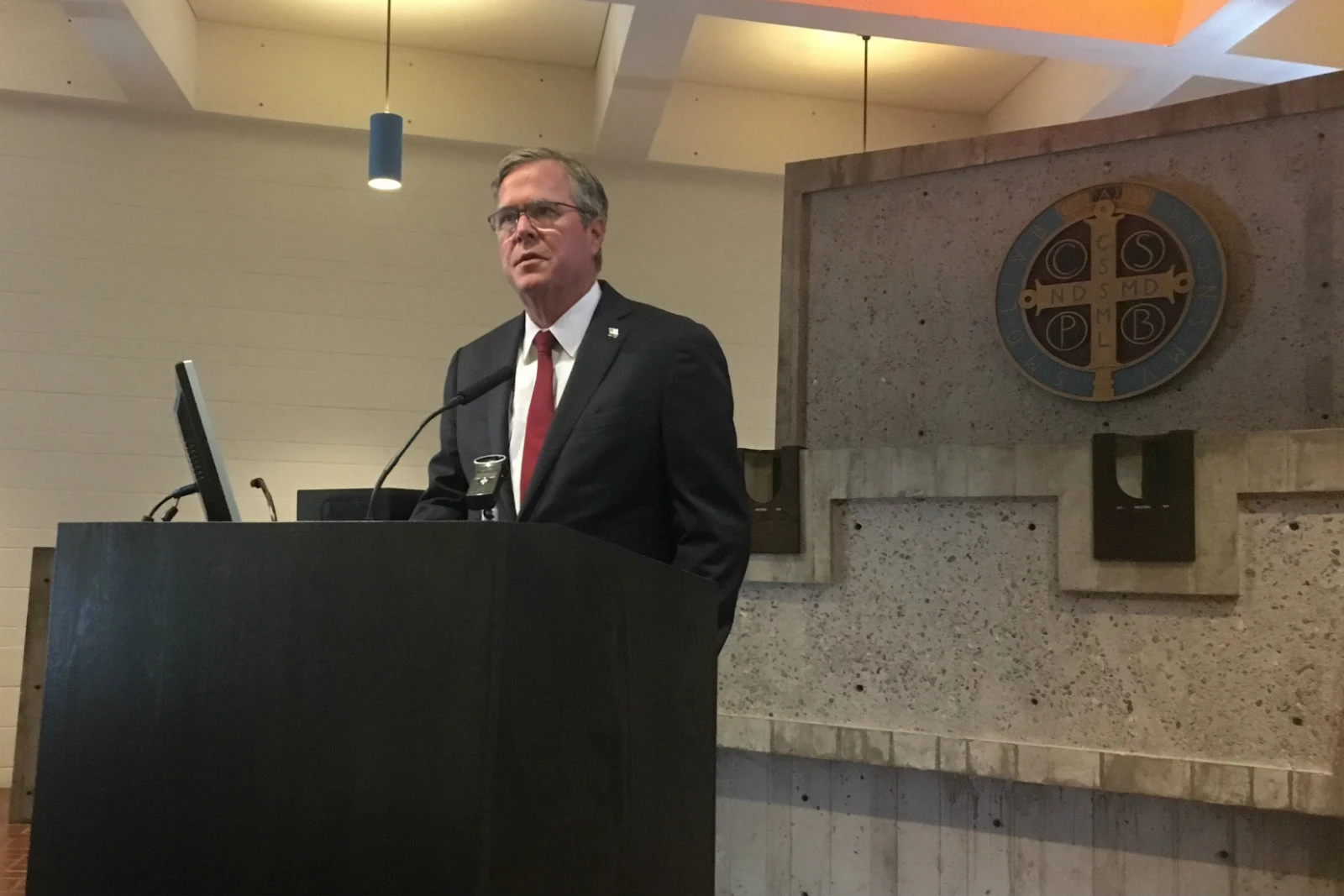
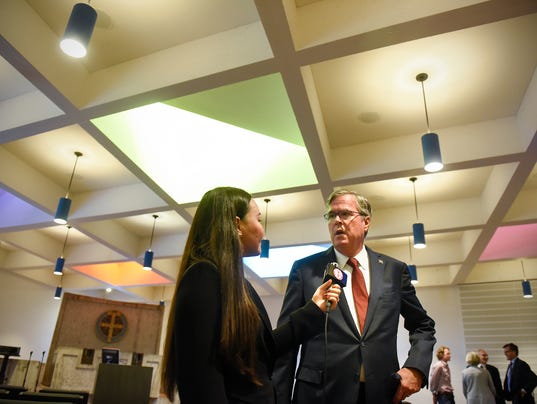
ST. JOSEPH — Gov. Mark Dayton said Wednesday he supports requiring universal background checks for gun sales in Minnesota, one of several high-profile gun proposals now before the Legislature.
Dayton also vigorously defended his proposal to overhaul the state tax code, decrying as “dishonest” those who say his plan would cost middle-class taxpayers as well as the wealthy.
The governor’s remarks came at a question-and-answer session with moderator Gary Eichten and College of St. Benedict and St. John’s University students, sponsored by the university’s McCarthy Center for Public Policy and Civic Engagement.
Eichten asked Dayton if he backs efforts to extend background checks to gun sales between private individuals and other sales now exempt from such checks.
“From the standpoint of common sense, that’s something I hope they’ll advance in the Legislature, and I’ll certainly support it,” Dayton said.
After the session, Dayton said he supported a federal requirement for universal background checks on gun sales when he served in the U.S. Senate. He said he now supports such a requirement at the state level.
A bill to address that issue was one of several gun proposals discussed in highly charged public hearings last week in the Minnesota House.
When asked if he would sign one of the bills implementing the universal-background-check requirement, Dayton said: “I won’t sign anything until I’ve read it, but again, I support the principle.”
President Barack Obama called for a federal requirement for universal background checks during his visit to Minneapolis last week.
Dayton also rejected suggestions that his budget proposal, released last month, would hurt the middle class. His plan to overhaul the tax code would hike tobacco taxes and income tax rates on the wealthy, broaden the sales tax to many services and some clothing purchases while lowering the rate, and give property-tax rebates of as much as $500 to homeowners.
“My tax proposals have always been specifically targeted at those who can most afford to pay more,” Dayton said.
January 9, 2013
Chuck Hagel's Afghanistan Positions Align Closely To Obama's, Despite War Critic Reputation
President Barack Obama is reportedly set to nominate former Sen. Chuck Hagel, a Vietnam veteran and outspoken critic of the war in Iraq, as his secretary of defense on Monday.
Hagel, a Republican who represented the state of Nebraska for two terms, famously broke with his party in the mid 2000s over the Bush administration's handling of the war on terror and its military adventures in Iraq and Afghanistan.
But while Hagel has built a solid reputation -- decried by the right and hailed by the left -- for being a no-nonsense war critic and foreign policy realist, he has also emerged as a quiet partner of President Obama on foreign policy, a relationship that dates back to their shared time on Capitol Hill and extending into Hagel's retirement.
That relationship is no better exemplified than in the debate over Obama's troop surge in Afghanistan, about which Hagel had been publicly skeptical but in the end a tactic he largely avoided criticizing as he had done previously with the surge in Iraq.
In 2006, as Congress debated supporting President Bush's troop surge into Iraq, Hagel fiercely opposed the plan, calling it "the most dangerous foreign policy blunder in this country since Vietnam."
Similarly, he often charged that a surge into Afghanistan would be a mistake if there was not a better-articulated overall strategy.
"I'm not sure we know what the hell we are doing in Afghanistan," Hagel told The National Journal's Michael Hirsh in 2010. "It's not sustainable at all. I think we're marking time as we slaughter more young people."
But his message on the Afghanistan troop surge was always more complex. In the summer of 2009, as the Obama administration studied the deteriorating situation in Afghanistan and prepared for a possible surge of troops into that war, Hagel offered surprisingly high praise for the president's deliberation process.
"It's a tough call -- I think it's going to be his toughest call in his first four years," said Hagel in a September 2009 speech at St. John's University in Minnesota. "Whatever he says, he's going to get hit politically ... You're going to have one hell of a shootout here. This guy Obama's smart enough, he's tough enough, he'll do what he thinks is right for the country."
In addition to praising the president, Hagel's own position has come more in line with that of Obama, whose thoughts on the surge were in evidence when the president was just a candidate calling for a renewed focus on Afghanistan.
"We are stretched too thin in Afghanistan, in my opinion, with manpower," Obama said on "Face the Nation" in July 2008, at a time when Hagel had still refused to endorse John McCain for president and was already fielding questions about whether he might take a cabinet position in an Obama administration. "We are going to have to put some additional troops in there."
By the summer of 2009, when General Stanley McChrystal delivered his Afghanistan troop assessment that called for tens of thousands of new forces, Hagel had gone from anti-war gadfly to an instrumental part of the Obama foreign policy machine, including positions on Secretary of Defense Bob Gates' defense policy board and Obama's intelligence advisory board.
"I've had some input on this," he said, during the 2009 speech, in response to a question about the surge. "I'm on the secretary of defense's policy advisory board, and I spent a day and a half last week with the national security adviser [James] Jones last weekend. So I have some ways in. Doesn't mean they listen to me, but I do have some sense of what's ahead here."
The speech, part of the Eugene J. McCarthy lecture series (which honors the famous senator-turned-Vietnam war critic), would have been an ideal environment for Hagel to express any strong misgivings about the ultimate plan to escalate the war in Afghanistan. Instead, Hagel tempered his critique.
"I think the president is approaching this very carefully, listening to all sides," he said. "I've talked to McChrystal, Admiral [Mike] Mullen. I've told them my thoughts on this because they've asked me. They've got to figure it out what is our strategic purpose, our doctrine, and then match the resources."
Posted: 01/07/2013 11:18 am EST
Updated: 01/07/2013 11:31 am EST
Joshua Hersh
October 15, 2012
Political Science Professor Jim Read Writes Op-Ed for Saint Cloud Times on the Proposed Voter ID Amendment
Voter ID doesn't prevent fraud
Proposed amendment will negatively affect students
On the ballot in Minnesota this year is a proposed constitutional amendment that may significantly affect the voting opportunities of college students, renters who move frequently, and others who for one reason or another lack the prescribed documents. At first it seems reasonable to require that you show a government-issued photo ID to prove who you are when you show up to vote. But proving who you are is only part of it. Proving where you live using government-issued ID is often the more difficult part.
Few college students have a driver’s license listing the college campus as their official residence. Instead it still lists their parents’ address in Duluth, Minneapolis, International Falls and so on. Of course students can apply for absentee ballots, or travel to their parents’ home on Election Day, or pay for a new driver’s license with new address before the old one has expired. But few will realize this until it is too late. Voting rates among college students would plummet if on Election Day they had to produce government-issued photo ID listing the address of their college residence.
Minnesota election law does not require this. Instead students living on campus can use university-issued photo IDs to vote if their university has provided the county with student residency information. Students living off-campus may use utility bills to prove residency or have someone registered in the district personally vouch for where they live.
What will happen to college students and others in comparable circumstances if the Voter ID amendment passes?
Everything depends on how the legislation implementing the amendment is written. Nothing in the actual text of the amendment rules out multiple types of photo identification and multiple methods of documenting residency, as under current law.
Voter impersonation could be prevented without burdening legitimate voters.
But many advocates of the proposed amendment push legislation that would impose significant new obstacles for college students and others with new addresses.
The Voter ID bill vetoed last year by Gov. Mark Dayton would have required government-issued photo ID with birth date and current address in the precinct — all on the same card. The bill specifically prohibited the use of student photo ID cards. A valid driver’s license showing a different address was invalid documentation for voting. Individuals could apply in advance for special Voter ID cards issued free of charge, but would have to apply for new cards every time they moved — perhaps even from one dormitory to another.
The real costs here are time costs: a bureaucratic obstacle course that imposes far-greater burdens on some voters than others.
Advocates claim such measures are necessary to prevent voter fraud. Yet a 2012 Carnegie-Knight investigation found only 10 cases of voter impersonation fraud nationwide since 2000, and none in Minnesota. How many thousands of legitimate voters are we willing to burden to prevent one rare (or nonexistent) case of impersonation?
Real election fraud — the kind that changes outcomes — happens when ballot boxes disappear, vote counts are falsely reported or voters of a certain race or political persuasion are prevented from voting. Fraud of that type has occurred often in U.S. history. Voter ID does nothing to prevent it.
I will vote “no” on this amendment. But the amendment itself is only Round One. If it passes, Round Two — how elected officials write the implementing legislation — immediately begins. Those who value the equal right of all citizens to vote should contact elected officials and candidates in both parties to insist that our election laws safeguard that right.
October 10, 2012
MPR's Kerri Miller to moderate panel at Saint John's on religion and politics on October 25
March 15, 2012
Griffin '09 Moots for Her Majesty
Barry Griffin (Class of '09), a law student at King's College in London, was one of four top students who had the pleasure to moot — participating in a simulated court proceeding — for Her Majesty, Queen Elizabeth II. As part of her diamond jubilee celebrations, the Queen was on hand to formally open Somerset House, the new home of King's College School of Law.
Griffin served as president of the law school's Bar Society and is currently president of The Bahamas Law Students' Association.
February 16, 2012
Letter: SJU students' spirit at caucus encouraging
The Republican caucus of Collegeville precincts 1 and 2 was held Feb. 7 at St. John’s University, with standing room-only attendance.
It was refreshing and encouraging to see some 40 St. John’s students of Precinct 2 enthusiastically participating and volunteering to be precinct officers and delegates to the next level. Several of these young men spoke in support of candidates, participated in the discussion of platform issues, and interacted in a positive way with the 20 community residents present.
This was a great example of making quality intergenerational connections. I commend these young men for taking the time to become involved in this grass-roots process, and encourage them to continue to be active.
Written by
Bill Lewis
Cold Spring
November 22, 2011
8 CSB/SJU students, professor volunteer for roadside cleanup

Eight students from the College of St. Benedict and St. John’s University, along with Professor Matt Lindstrom, director of the Eugene J. McCarthy Center for Public Policy and Civic Engagement at St. John’s, volunteered for the center’s first roadside cleanup. The McCarthy Center recently adopted a 3.2-mile stretch of highway south of Avon. The cleanup was Oct. 9. The McCarthy Center will invite members of the CSB/SJU community to participate in this cleanup again each spring and fall. Photo submitted by Melissa DeOrio, Eugene J. McCarthy Center for Public Policy and Civic Engagement Written by
Submitted by Melissa DeOrio
Eugene J. McCarthy Center for Public Policy and Civic Engagement
Filed Under
Citizen Times
College Of St. Benedict
Eight students from the College of St. Benedict and St. John’s University, along with Professor Matt Lindstrom, director of the Eugene J. McCarthy Center for Public Policy and Civic Engagement at St. John’s, volunteered for the center’s first roadside cleanup. The McCarthy Center recently adopted a 3.2-mile stretch of highway south of Avon. The cleanup was on Oct. 9. The McCarthy Center will invite members of the CSB/SJU community to participate in this roadside cleanup again each spring and fall.
EmailPrintShare LinkedIn Tumblr StumbleUpon Reddit Del.icio.us Digg AA
June 21, 2011
FactCheck.org founder spends week at SJU
Written by
Mark Sommerhauser
msommerhauser@stcloudtimes.com
Like to follow politics through blogs, Facebook and Twitter?
Use of these and other social-networking platforms may encourage voters to type first and think later, a political expert with Central Minnesota ties said Tuesday.
Kathleen Hall Jamieson directs the Annenberg Public Policy Center at the University of Pennsylvania and helped found FactCheck.org, a pioneering website that scrutinizes statements made by politicians in ads and debates.
Jamieson this week is a scholar-in-residence at the Eugene J. McCarthy Center for Public Policy and Civic Engagement at St. John’s University. That puts Jamieson in familiar territory, as she’s a 1964 graduate of St. Benedict’s High School in St. Joseph.
Few dispute that social-networking platforms have had a growing influence on politics in recent years.
That’s not necessarily bad, Jamieson said in a Tuesday afternoon interview with the Times. Such platforms help people connect with each other, and help them aggregate political information.
But they also may foster a climate in which observers continually comment on political speeches or debates, without pausing to consider or digest what politicians are actually saying, Jamieson suggested. She questioned how this could affect “our capacity for thoughtful citizenship and reflective engagement.”
Politics also is being changed by the emergence of technology to individualize Internet advertising, Jamieson added. That could occur when advertisers use a person’s Internet-surfing history to tailor political emails or ads to that individual.
The result: Different voters hear different political messages — and perhaps, different promises. That’s not necessarily a problem if the claims are accurate — but could be if they’re not, Jamieson said.
“Nothing in the media structure is set to capture these messages, to provide a forum to debunk them,” Jamieson said.
Jamieson also stressed the importance of educating high school students on civics — and on how to distinguish when a politician is telling the truth or when they’re fibbing. Increasing emphasis on core subjects like math and reading mustn’t displace such education, Jamieson said.
“It’s also important,” she said, “that we haven’t crowded an understanding of civics out of our curriculum.”
February 15, 2011
Denis McDonough

Denis McDonough is the National Security Council's chief of staff and one of President Obama's closest advisers. Mr. McDonough is reportedly so close to the president that colleagues — even his superiors — often do not make a major move without first checking with him.
Mr. McDonough is well known for picking up the phone to take people to task, from reporters to Washington talking heads to other Obama officials who go off message. He has berated some of the Democratic Party's most distinguished foreign policy dignitaries when they have dared to critique Mr. Obama publicly.
Mr. McDonough began his Capitol Hill career as an aide to the House International Relations Committee, where he focused on Latin America. He went on to work for Tom Daschle, the former South Dakota senator and former Senate majority leader, rising to senior foreign policy adviser, and became legislative director for Senator Ken Salazar of Colorado after Mr. Daschle's re-election defeat. He was then a senior fellow at the Center for American Progress, a Democratic-leaning policy organization, before joining the Obama campaign.
During the campaign, Mr. McDonough took on the role of Mr. Obama's foreign policy guru. He helped synthesize the contributions of some 300 foreign policy advisers, divided into teams based on regions and issues, to assist Mr. Obama in formulating and articulating his foreign policy. Mr. McDonough was often dispatched to brief reporters about Mr. Obama's positions.
His work during the campaign sealed his role as Mr. Obama's most trusted foreign policy aide in the White House.
He was born Dec. 2, 1969, in Stillwater, Minn. He graduated from St. John's University in Collegeville, Minn., and has a master's from Georgetown University.
February 8, 2011
Parker Rosen, LLC Announces Mark Kennedy as Senior Strategic Adviser
January 14, 2011 11:22 AM Eastern Time
Parker Rosen, LLC Announces Mark Kennedy as Senior Strategic Adviser
Former Congressman Adds Depth to the Firm’s International Public Affairs Practice
MINNEAPOLIS--(BUSINESS WIRE)--Minneapolis-based law firm Parker Rosen, LLC, (www.parkerrosen.com), announced today the addition of Mark Kennedy as a Senior Strategic Adviser. Kennedy brings a broad background in business, public service and global initiatives to his role at Parker Rosen, a firm well known for its involvement in Minnesota politics, civic activities and public affairs in addition to its winning tradition in the courtroom representing local, national and international business clients.
“I’m thrilled to be joining Parker Rosen,” says Kennedy. “I’ve long admired the wise counsel and winning results of the firm, its commitment to its clients and its active involvement in bringing people together through its community and public affairs work.”
In his role at Parker Rosen, Kennedy will focus his practice on assisting clients with global public affairs strategy and international conflict resolution matters. Kennedy is also Chief Executive Officer of Chartwell Strategic Advisors, LLC where he applies his experience in both business and government to help clients achieve success in the increasingly globalized and competitive world.
According to Parker Rosen Co-founder, Andrew Parker, “Mark shares our belief that law firms must be focused on results and that achieving results requires expert advice. Mark’s experience in global business and government will help Parker Rosen continue to achieve the results that our clients need and expect in the ever-evolving environment of business and the law.”
Prior to joining Parker Rosen and forming Chartwell Strategic Advisors, Kennedy was in a global role with Accenture, a leading management consulting firm. He represented Minnesota in the United States House of Representatives for three terms from 2001 through 2007. Kennedy also served as a Presidential appointee to the Advisory Committee on Trade Policy and Negotiation under both Presidents Bush and Obama (2007 – 2010). Prior to his service in Congress, Kennedy held leadership roles with some of the area’s largest employers, including Pillsbury, Macy’s and ShopKo (then a subsidiary of SUPERVALU). Trained as a Certified Public Accountant, Kennedy was recognized by Institutional Investor in a feature on America’s Top CFOs.
An active speaker, Kennedy has also founded or co-founded three lecture series: the Minnesota Rough Riders, the Frontiers of Freedom Lecture Series at St. John’s University and the Economic Club of Minnesota (www.ecomn.org). He will continue to speak before civic, government, student and business groups in his role at Parker Rosen.
Kennedy is a graduate of St. John’s University and received his Master’s in Business Administration with distinction from the Ross School of Business at the University of Michigan. He and his wife, Debbie, live in Watertown, Minnesota.
Parker Rosen, LLC (www.parkerrosen.com) is a Minneapolis-based law firm that represents select major corporations, small businesses, and other private and institutional clients in complex civil and commercial litigation, labor and employment litigation and investigations, eminent domain, real estate, and land use law, appellate advocacy, education law and, international law and public affairs. The firm looks to make a difference – in legal matters within the Twin Cities market and throughout the world – by bringing people with diverse backgrounds together to build a unified community.